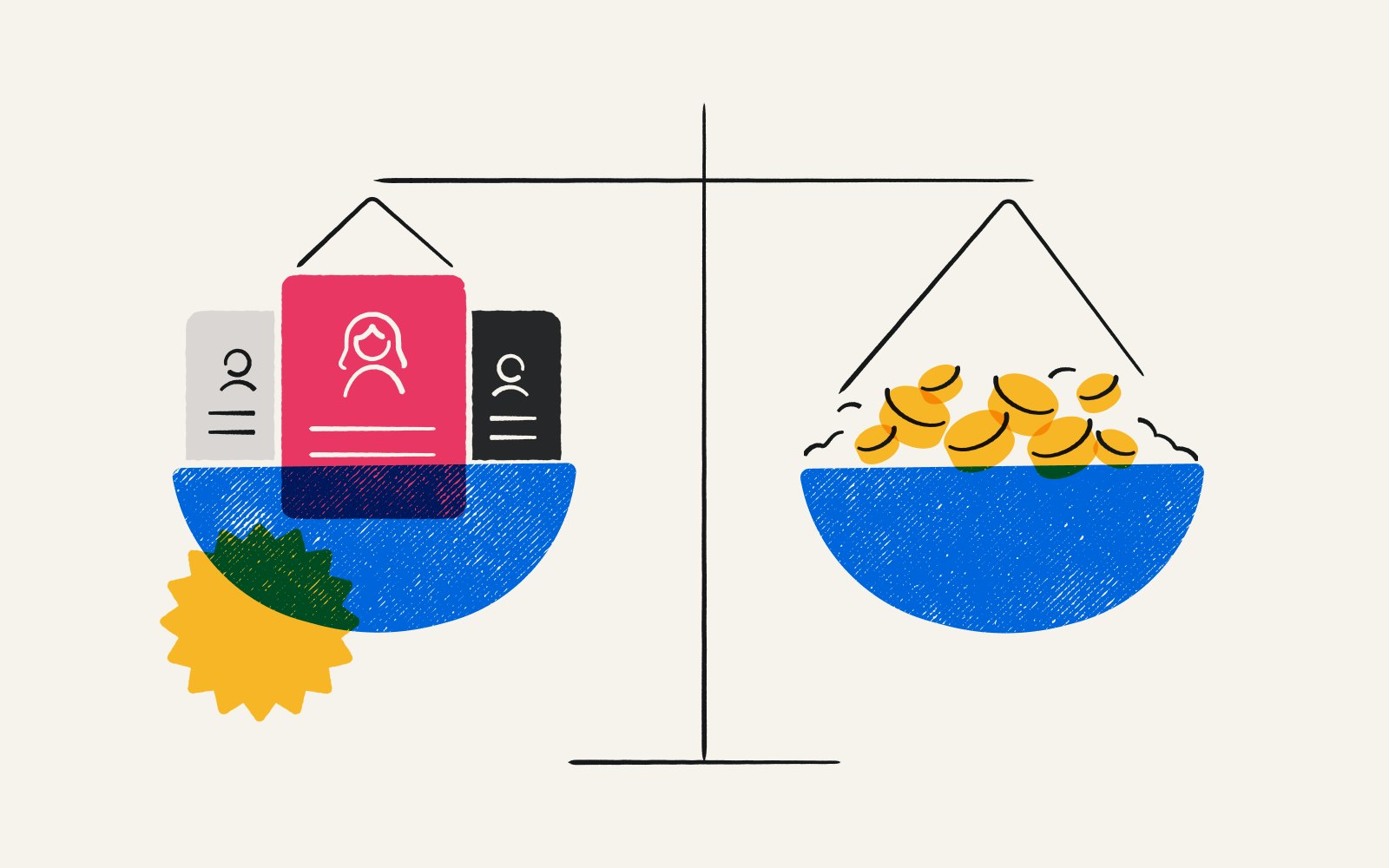
Research costs are rising across all methods. Face-to-face and computer-assisted telephone interviews are seeing the sharpest price increases, according to Research World’s analysis of ESOMAR’s Global Prices Study 2025, but online research costs are climbing too.
It may be tempting to scale back on incentives as research costs grow. But as top teams understand, incentives are your strategic lever. Survey incentives significantly increase response rates, according to a 2023 meta-analysis of 46 randomized controlled trials. Plus, the right rewards can help you attract the right people, improve feedback quality, and keep participants engaged.
So how can you maximize your research budget while effectively attracting participants to complete surveys and other studies? In this guide, you’ll learn what drives incentive costs, where teams overspend on them, and how to design incentives that deliver strong results while staying within budget.
What factors impact incentive costs in market & UX research?
In general, incentive costs are higher when recruitment and retention are more challenging. The following considerations drive costs.
Method and effort
Studies that involve long surveys, extensive interviews, repeated feedback sessions, or multi-day diary entries typically require higher incentive costs. And the duration of the study matters: following software users over six months requires higher incentives than a one-off survey.
Costs also increase when participants need to perform emotionally or cognitively demanding work. For example, research teams can expect to spend more on incentives if caregivers must relive stressful medical emergencies, or if systems engineers must walk through complex formal verification prototypes.
Audience
General consumer audiences are often willing to participate in low-effort studies for small, non-cash rewards. Consumers may happily sign up for a study on ice cream flavors in exchange for free samples.
In contrast, niche B2B audiences and participants in specialized or senior roles — such as executives in energy supply chain logistics — expect higher, cash-equivalent incentives because their time is limited and commands a higher value.
Geography
Incentives generally reflect local cost-of-living and payment preferences. Participants in Switzerland, one of the most expensive countries in the world, typically receive higher incentives than participants in Belarus, where living costs are much lower. Even within the same country, living expenses can vary, shaping the incentives needed to attract high-quality participants.
Mode and channel
Recruiting participants from scratch based on specific criteria — for example, CTOs at mid-sized companies — is challenging and typically requires higher incentives. Using an existing panel of participants is usually less costly. Recruiting customers who’ve already used your product is typically the least costly method since you already have a relationship with them.
Where do research teams typically overspend on incentives?
Now that you understand the factors that influence incentive costs, it’s time to break down the most common reasons research teams overspend on them.
Poor study design
While research incentives significantly increase response rates, they can’t make up for ineffective screener surveys, confusing question wording, or sloppy methodology. These factors can all reduce response rates, and it’s important to address them before increasing incentives.
Flat rates
Tailoring your incentives for the study and audience is a crucial step. Participants generally expect lower incentives for a five-minute survey versus a 30-minute interview. Plus, our research shows that different groups of participants have different compensation expectations. Students expect 20% less than other groups, while participants who make $200K+ per year expect 46% more.
Filtering failures
Today, a third of study participants admit to using AI tools to help them answer online survey questions.
With more people using AI, it’s harder to filter out fraudulent and duplicate respondents, and many research teams end up wasting incentive dollars on bad data. It’s important to use fraud-detection tools and dedicate staff time for manual review, identity checks, and ongoing monitoring.
Slow payment methods
Participants appreciate quick, easy-to-use payment methods. Our research found that study participants perceive cash transfers as the highest value incentives, with Visa prepaid gift cards as the next best option. Checks rank last. You need to pay $13.37 more by check if you want your participants to perceive it as equal in value to cash.


Designing effective research incentives: A practical framework
Need to design incentives for a survey or study? Follow this step-by-step guide.
Step 1: Review industry benchmarks
First, find out what other companies and research teams like yours are paying for incentives. You can check recent industry reports for benchmark ranges and review listings for participants to find out what similar teams are offering. Reddit communities like r/beermoney and r/passiveincome frequently share survey listings, along with user-reported incentive rates. You can also use our research incentive calculator to help determine the right amount for your study.
Step 2: Match incentive types to your research method and audience
In general, monetary incentives yield the highest response rates. For surveys or quantitative studies, gift cards and points that can be redeemed for rewards are often effective. For shorter consumer surveys, a sweepstakes may work well. For example, instead of paying each participant individually, you may want to enter them into a drawing for a $200 gift card.
For UX and qualitative studies, which require more of participants’ time and effort, individual cash equivalents are typically most effective. The more cognitively demanding the study, the higher the incentives you may want to offer. Experimental research at Cornell University suggests higher incentives can actually increase participants’ cognitive effort, as measured by longer response times. Higher incentives were also linked with better performance and more sophisticated choices.
Step 3: Localize incentives for different geos
Factor in the cost of living and preferred payment methods in the geographic region when setting your reward amounts.
Popular payment methods by region include:
United States: Digital gift cards, PayPal or Venmo payments
United Kingdom or European Union: Bank transfers or major retail vouchers
Latin America: Mobile wallet payments, PayPal payments, or cash equivalents
Asian and Pacific countries: E-commerce gift cards or payment via super-apps like AliPay or WeChat Pay
Step 4: Gather feedback and optimize
After conducting a study, track the percentage of participants who redeem the incentive and divide it by the total number of participants to determine the redemption rate. Compare redemption rates for different incentive strategies, and collect qualitative survey feedback about your incentives. Then use this data to refine your approach.
Tips to maximize your budget without underpaying participants
These strategies can help ensure you design a successful study, stay within budget, and provide meaningful incentives that drive results.
Tighten targeting and study design
Studies have the best chance of success when you clearly define your target audience. A well-defined audience makes it easier to recruit qualified participants quickly and avoid paying for unqualified responses. Study design also matters. For surveys, that means designing a mobile-friendly, accessible survey that optimizes screener questions, survey length, question order, question wording, and answer scales. Non-survey studies, such as interviews or diary studies, also benefit from clear instructions and participant-friendly design.
Test tiered incentive structures
Offering your participants a portion of their incentive upfront and a portion upon completion can boost response rates, according to a study by Conn Health Telemed. As a bonus, you won’t pay the full incentive if a participant drops out halfway through the study.
Test sweepstakes or single larger prizes
If you’re conducting a quantitative survey, test whether a sweepstakes boosts response rates as well as individual incentives. Make sure your sweepstakes meets local legal requirements.
Reduce operational waste
When research teams are inefficient, budgets pay the price. To help your incentive budget go as far as possible:
Implement screening tools to weed out unqualified participants up front
Use a single incentive vendor to keep things running smoothly
Eliminate manual processes to save time and prevent errors
Invest in fraud prevention tools to improve data quality
Key takeaways
Research costs are on the rise, but with thoughtful incentive strategies, you can attract qualified participants, collect high-quality data, and stay within budget. Keep these takeaways in mind:
Understand what drives costs. Your study design, audience, geographic region, and the mode and channel you use to recruit participants all influence incentive amounts.
Avoid common overspending pitfalls. Poor study design, offering flat incentive rates, failing to filter out duplicate and fraudulent respondents, and offering unpopular payment options can inflate costs.
Design smarter incentives. Review industry benchmarks, match incentives to your research method and geography, and gather feedback about your incentives after each study.
Maximize efficiency. Consider tightening your study design, testing tiered incentive structures, offering a sweepstakes or single larger prize, and optimizing your operations to reduce waste.