Marketing referral incentives that work: what consumers say actually motivates them
By Mindy Woodall●5 min. read●Aug 28, 2026
Referral marketing runs on a simple premise: your happiest customers will bring you new business by telling people they know about your brand. And offering a reward can encourage customers to spread the good word about a product or service they already love.
But how do you know how much to offer? What types of rewards actually motivate customers to refer others? And do rewards really make a difference, or would people tell their friends and family about your business either way?
We surveyed U.S. consumers about what motivates them to refer other people to products and services they like. What they told us can help your marketing team structure incentives for maximum effect.
Key takeaways
Rewards drive action: 75% of people who reported recently referring someone to a product/service did so for a reward. And it doesn’t have to be huge: 79% said $10 or less would motivate them to refer people to a product/service they like.
Gift cards where the referrer can choose the brand are even more appealing (74%) than cash (72%). Together, these two are the most popular reward types.
People prefer when their family and friends get rewarded as well. 64% of respondents ranked a shared reward between them and the person they refer as the most appealing reward structure, even beating a setup where they get twice the amount but the person they refer gets nothing.
Speed matters: 82% of respondents expect their reward to arrive within a week.
Friction is the biggest referral killer. 67% of people report having abandoned a referral mid-process because there were too many steps. And 76% say a bad payout experience would make them at least somewhat less likely to refer people to a brand again, even for products they love.

Rewarded referrals edge out unrewarded ones
Most U.S. consumers are already making referrals, with or without rewards. 95% of survey respondents have referred people to a product or service, and 91% said they’ve done so within the past 12 months.
Among people who had referred someone over the last year, 75% did so for a promised reward vs. 62% who referred people with no reward attached. (Respondents could report both.)
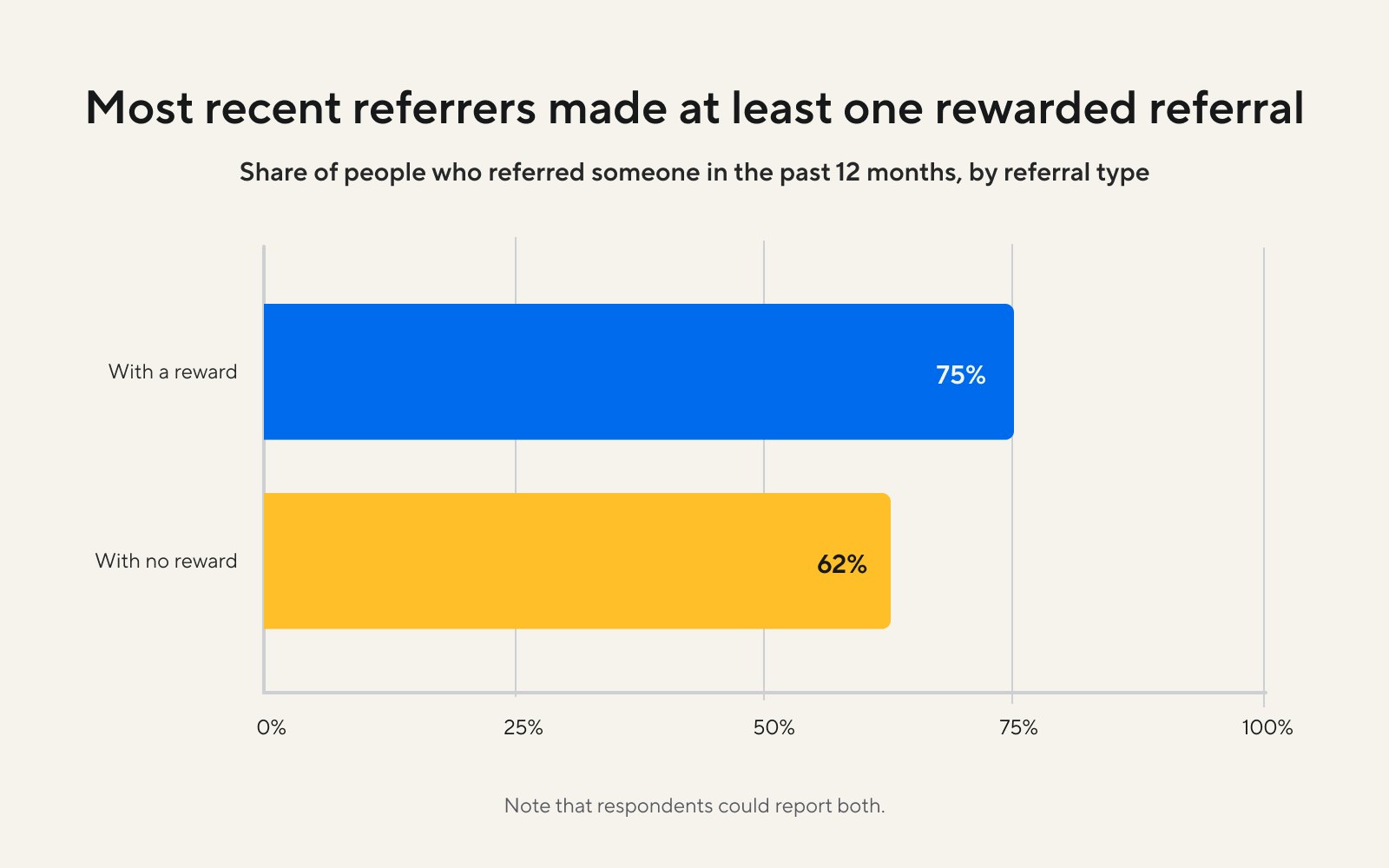
While people are willing to make referrals even without a reward, an incentive may bump up your odds of landing a new sale. And your pool of potential referrers seems to be nearly everyone.
When asked to choose all the product categories they most often make referrals in, people reported:
Streaming and subscription services (49%)
Banking and fintech services (47%)
Retail and e-commerce platforms (43%)
Travel services (37%)
People are willing to refer for free, but rewards turn that intent into action
When we asked respondents whether they would refer someone to a product or service they liked even with no reward at all, only a small portion of people (5%) said probably not or no. The vast majority are willing to tell their friends and family about brands they enjoy.
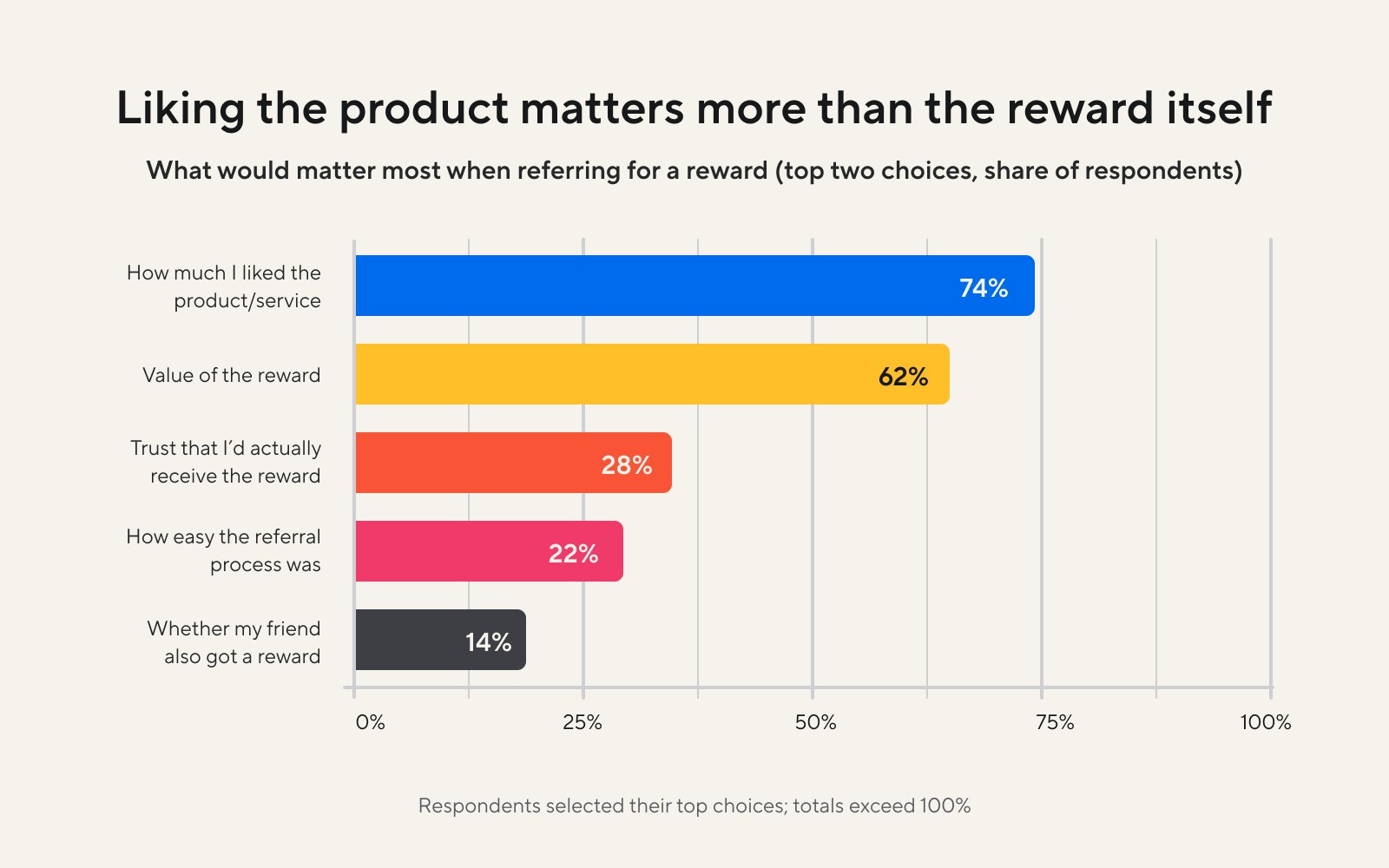
Even for rewarded referrals, genuine enthusiasm for the product seems to motivate people more than the reward itself. When asked what matters most when deciding to refer someone for a reward, "how much I liked the product/service" came out on top at 74%, ahead of the value of the reward itself at 62%.
So why offer rewards at all? Because willingness and action are different things. A reward gives someone a reason to prioritize referring others and push through your signup flow instead of just mentioning your brand in conversation. The data we gathered on people who’ve made referrals within the last year bears this out by showing that rewarded referrals outpaced unrewarded ones.
Small rewards work well
The threshold for motivating action might be lower than you think. When we asked respondents the lowest reward value that would motivate them to actively refer someone to a product they already like:
21% said $1 would be enough
56% said $5 or less would work
79% said $10 or less would motivate them
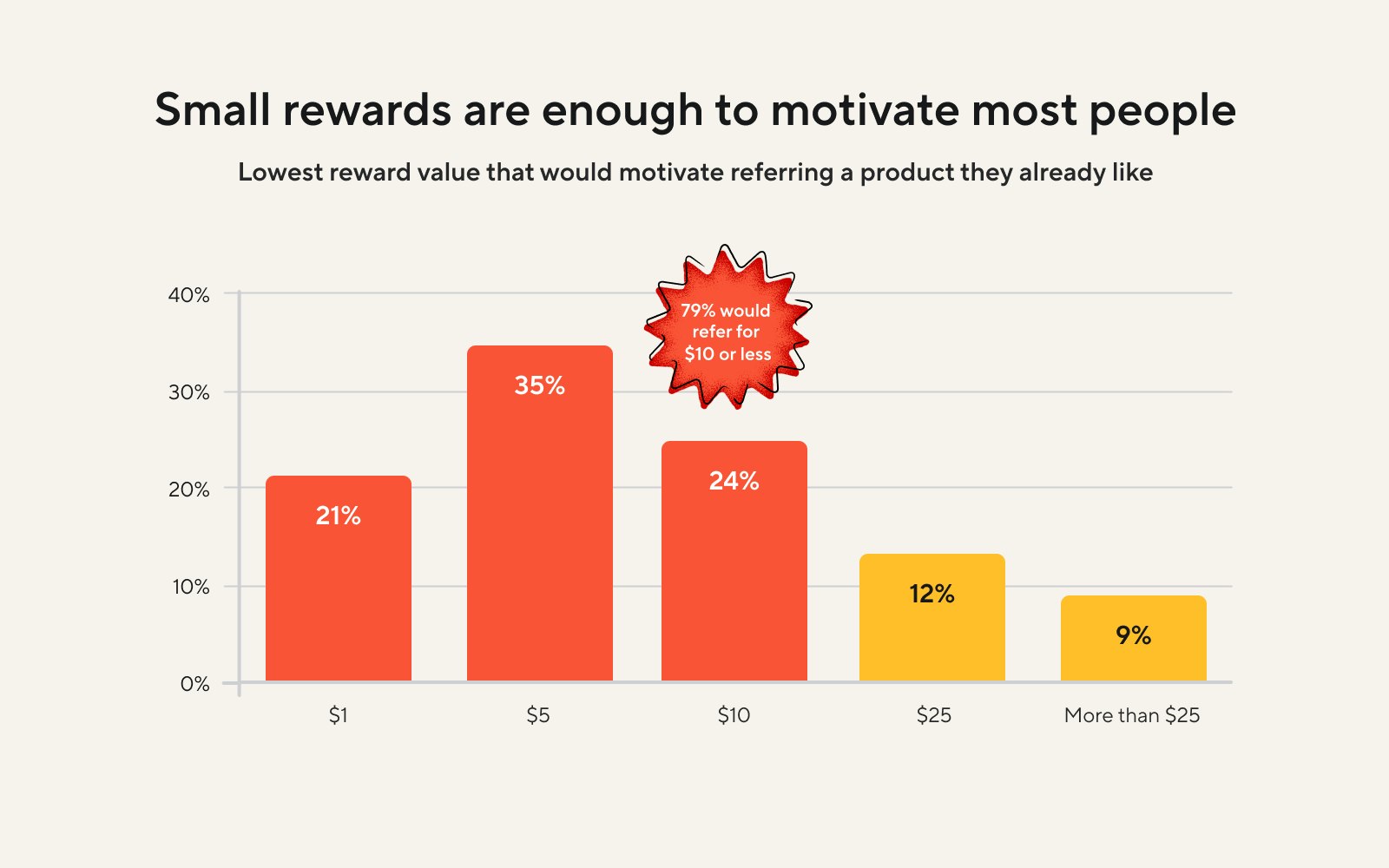
Only 9% reported needing more than $25 to feel motivated to make a referral. If people already like your product, then even a modest reward amount can be enough to prompt action.
Customers prefer gift cards (of their choice) and cash
When respondents listed their top three most motivating reward types, two options clearly dominated:
Gift card to a brand of their choice: 74%
Cash: 72%
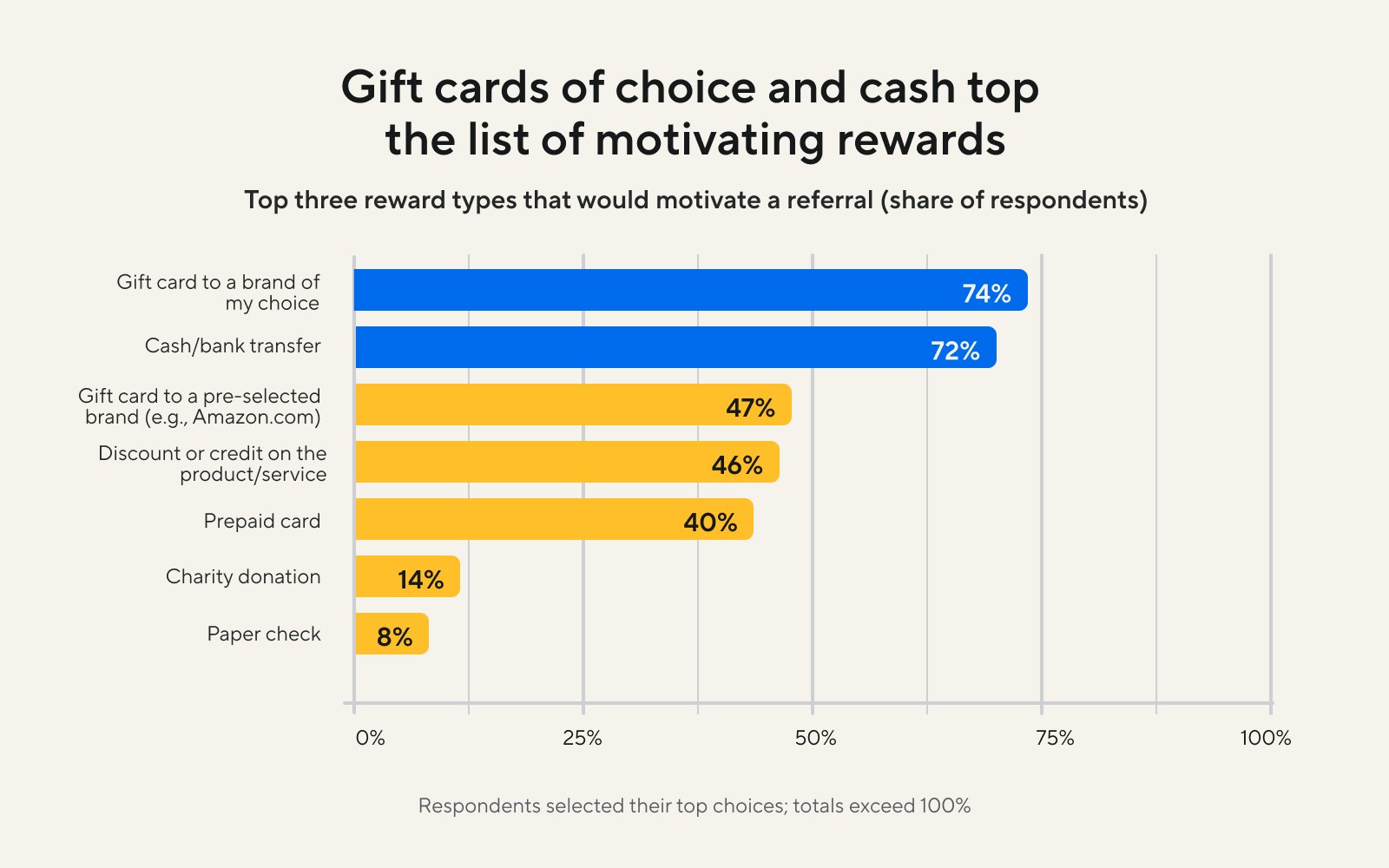
A pre-selected gift card like Amazon.com or DoorDash trailed at only 47%, roughly tied with a product discount/credit at 46%.
Prepaid cards came in at 40%. And it’s safe to say that very few people want paper checks. They only made it into 8% of respondents’ top-three choices.
The gap between "gift card of my choice" and "pre-selected gift card" is nearly 28 percentage points. That’s a strong argument in favor of using a reward platform that lets people choose which gift card they want to get, rather than buying gift cards from a single brand.
Customers who make referrals want their friends to get something too
This was the most striking finding in the survey. We asked respondents to rate four reward structures for a $20 total budget from most to least appealing:
$10 for me, $10 for my friend
$20 for me, nothing for my friend
$15 for me, $5 for my friend
Nothing for me, $20 for my friend
Almost two-thirds (64%) of respondents rated the equal split between them and their friend as the most appealing reward option. That’s compared to only 36% who chose “$20 for me, nothing for my friend” as the most appealing option.
It’s notable that most respondents rated receiving $10 with a matching $10 for their friend higher than receiving the full $20 themselves. It seems important to most people that the person they refer get something out of the deal as well.
And this seems to be out of pure generosity rather than not wanting a reward at all. When asked if they’d be more or less likely to refer a friend if their friend knew they were getting a reward for doing so, only 3% said they'd be less likely to refer. In fact, 32% said they'd be more likely to refer someone if their friend knew they were getting a reward out of it.
Timely reward delivery matters
Consumers have high expectations around payout speed. 35% of respondents expect their reward within one day of their friend signing up, and another 48% expect it within a week. Only 6% said timing doesn't matter to them.
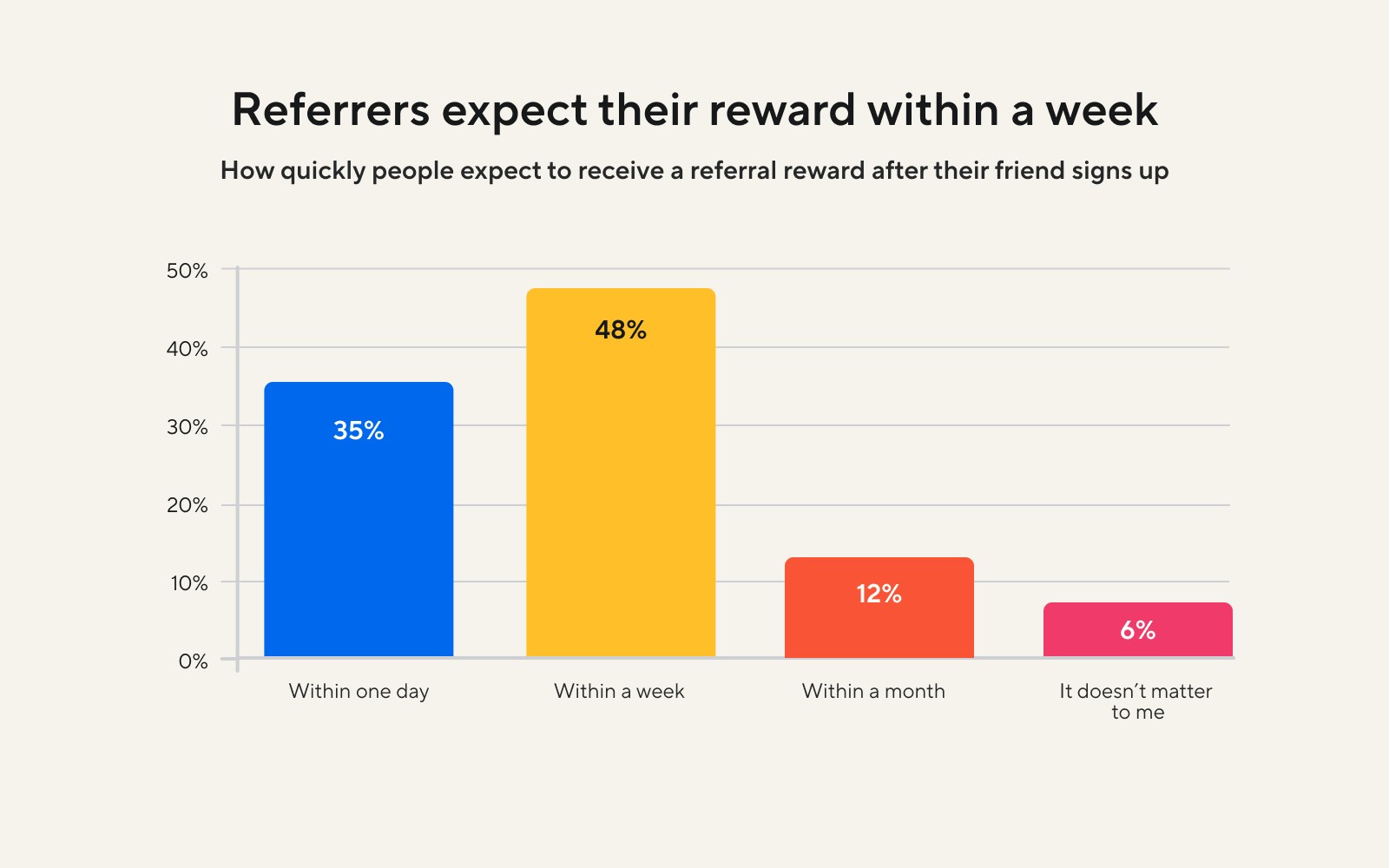
If your program pays out on a monthly cycle or after a lengthy qualification window, you could be outside the expectations of more than 80% of potential referrers. A reward platform can make it easier to get rewards out the door immediately rather than wrangling gift card delivery from a spreadsheet.
Friction kills more referrals than small rewards do
Two-thirds of respondents (67%) reported having started an official referral process and abandoning it before submitting. Among reasons why they stopped the process, the top two most commonly chosen were:
“Too many steps in the process” at 47% of respondents
“The reward was too difficult to qualify for” at 35% of respondents
Compare that to “The reward felt too small” at only 20% of respondents.
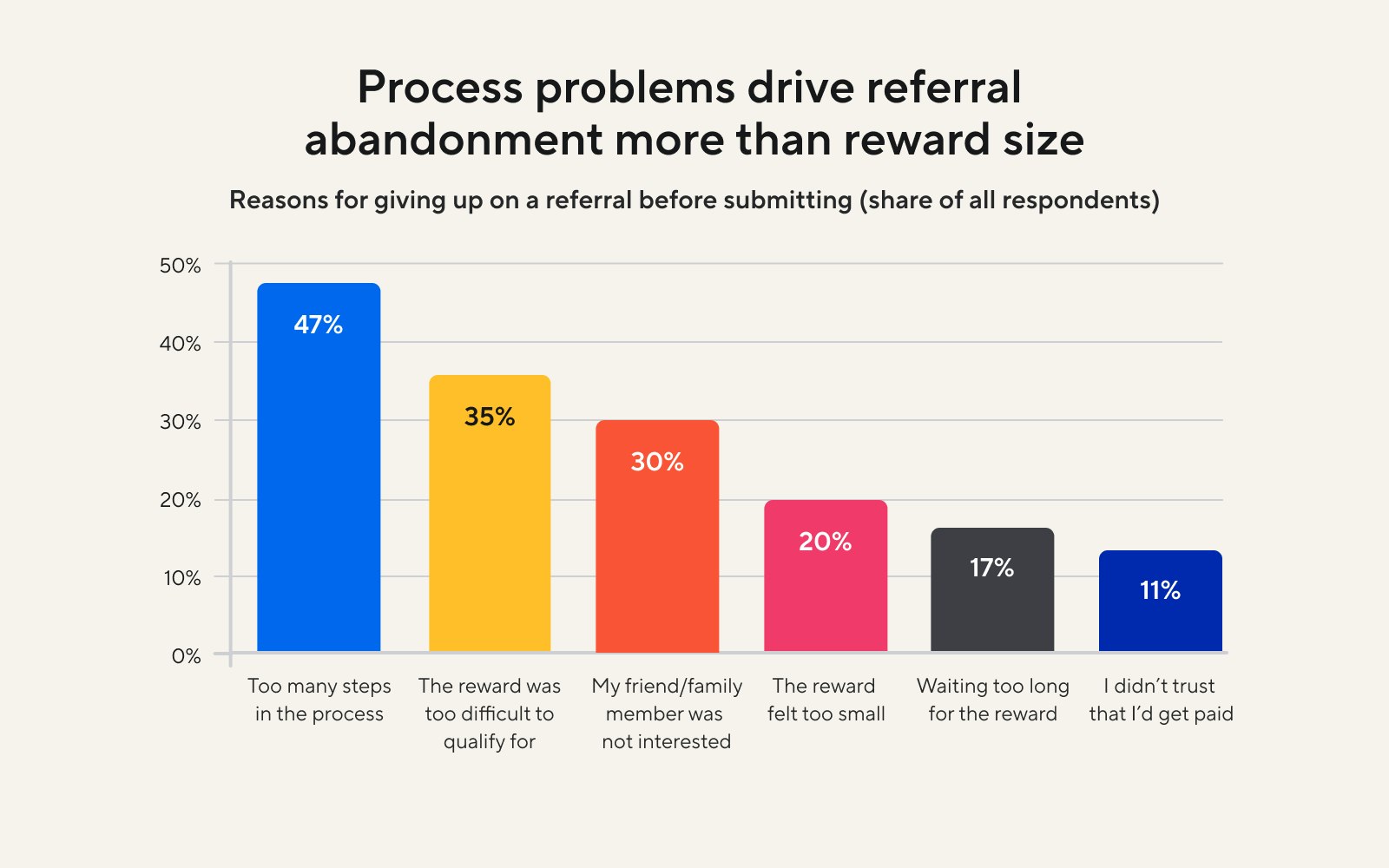
Process friction, whether it’s too many steps or difficult qualification requirements, outranks reward size as a reason to give up on a referral. A program that pays $25 through a five-step flow with fine-print qualification rules might lose referrals that a $5 program with a one-click share link could capture.
A bad payout experience could cost you future referrals
Referral rewards are a customer experience touchpoint, and customers will remember one that doesn’t go well.
We asked whether a difficult reward experience like a delayed payout would make respondents less likely to refer someone to that brand again, even for a product they genuinely love. 76% said a bad experience would make them either “much less likely” or “somewhat less likely.” Less than a quarter said it would have no effect.
A late or clunky reward payout can cost you a customer who was previously happy with your brand.
What this means for your referral program
A few practical recommendations from the data for your own program:
Don't worry too much about reward size. Most people will act for $10 or less if they like your product. Enthusiasm is the more important factor, although rewards still matter for prompting happy customers to refer others.
Let customers choose their own gift cards (or give them cash). Gift card choice was the most commonly preferred reward option.
Make the reward benefit both parties. A 50/50 split between the referrer and their friend might be preferable to giving just the referrer a higher reward.
Pay as quickly and smoothly as possible. More than 80% of referrers expect their reward to be delivered in less than a week.
Audit your flow for friction. Count the steps, simplify the qualification rules, and make the terms as clear as possible. Process problems seem to drive more abandonment than small rewards do.
Treat payouts as part of the customer experience. Most respondents said they’d be less likely to refer after a bad payout experience.
People already want to recommend things they love. The job of your referral program is to turn customers’ good intentions into action that can benefit your brand.

Methodology
Survey of 101 U.S. consumers conducted in August 2026. Percentages may not sum precisely to 100 due to rounding or multi-select questions.