From spreadsheet chaos to automation: How to painlessly scale marketing incentives
By Abby Quillen●Jul 15, 2026
If you started your marketing incentive program by buying and sending gift cards one at a time and tracking them on a spreadsheet, you're not alone. Many teams start there, and it works until it doesn't. As your program grows, simple processes can turn into hours of busywork.
That doesn’t mean marketing incentives aren’t worth it. Customers love rewards, and reward programs deliver measurable results. More than 90% of loyalty program owners who measure performance report positive ROI from their programs.
The challenge is making incentives work at scale. The fix isn't more hours, it's automation. Replacing manual sends with rules-based workflows speeds up payouts, reduces errors, and gives you back the time to improve your program instead of just running it.
Key takeaways
Manual programs break down as volume grows. Reward fulfillment eats time, the recipient experience gets inconsistent, international delivery adds complexity, performance is hard to track, and errors and fraud drain budget.
Start small, then scale. Move from spreadsheets to automation with one program and a limited group of recipients, then follow a defined set of steps to build reliable workflows.
Automation pays off across program types, including sign-up and acquisition incentives, referrals, cashback and rebates, loyalty and rewards programs, and incentives for webinars, demos, and events.
The strongest platforms send high volumes triggered by customer actions. Look for integrations with your tech stack, global reach, a real-time reporting dashboard, transparent pricing, built-in fraud prevention, and recipient support.
Why manual incentive programs break down at scale
Here are the most common reasons manual systems break down as incentive volume grows:
Administrative overhead: Manually emailing rewards one at a time, chasing down who received them, following up with non-responders, and reconciling spend requires significant staff time.
Inconsistent recipient experience: With manual processes, rewards often get delayed. Recipients grow frustrated waiting on rewards, which chips away at the goodwill the program is meant to build. Staff also field the resulting complaints, adding to the workload.
International complexities: As programs grow to reach a global audience, navigating cross-border transactions, currency conversion, country-specific regulations, and tax reporting obligations gets complicated.
Limited visibility: Without real-time tracking and reporting, teams struggle to see where money is going and what's actually working. Maintaining auditable records for compliance is also slow and manual.
Budget loss: A study of human data entry in clinical trials found a pooled error rate of 6.57%, showing that even structured manual entry introduces inaccuracies. Those errors get expensive when they hit payouts and financial reporting. Marketing incentive programs are also frequent fraud targets, including fake accounts, bot redemptions, referral abuse, and promotion stacking (combining multiple incentives in an unintended way). When you track data by hand, fraud patterns are hard to catch in real time, which drains marketing dollars.
What it means to automate marketing incentives
Automation swaps manual sending for workflows that deliver rewards on their own, triggered by events you define. Each workflow runs in five steps:
Trigger: An event kicks off the reward, like a sign-up, referral, purchase, or event RSVP.
Rule: A condition decides whether the customer qualifies and sets the reward amount.
Reward: The system generates the reward and assigns it to the recipient.
Delivery: The system sends the reward through your chosen channel, whether that's email, text, or another option.
Tracking: The system records when the reward was delivered, opened, and redeemed and monitors financial data.
Automated doesn't mean one-size-fits-all. With the right platform, you can use dynamic fields to let recipients pick rewards in their own language and currency. You might show US recipients options from US retailers priced in dollars, while recipients in Europe see catalogs built around local retailers, languages, and currencies.
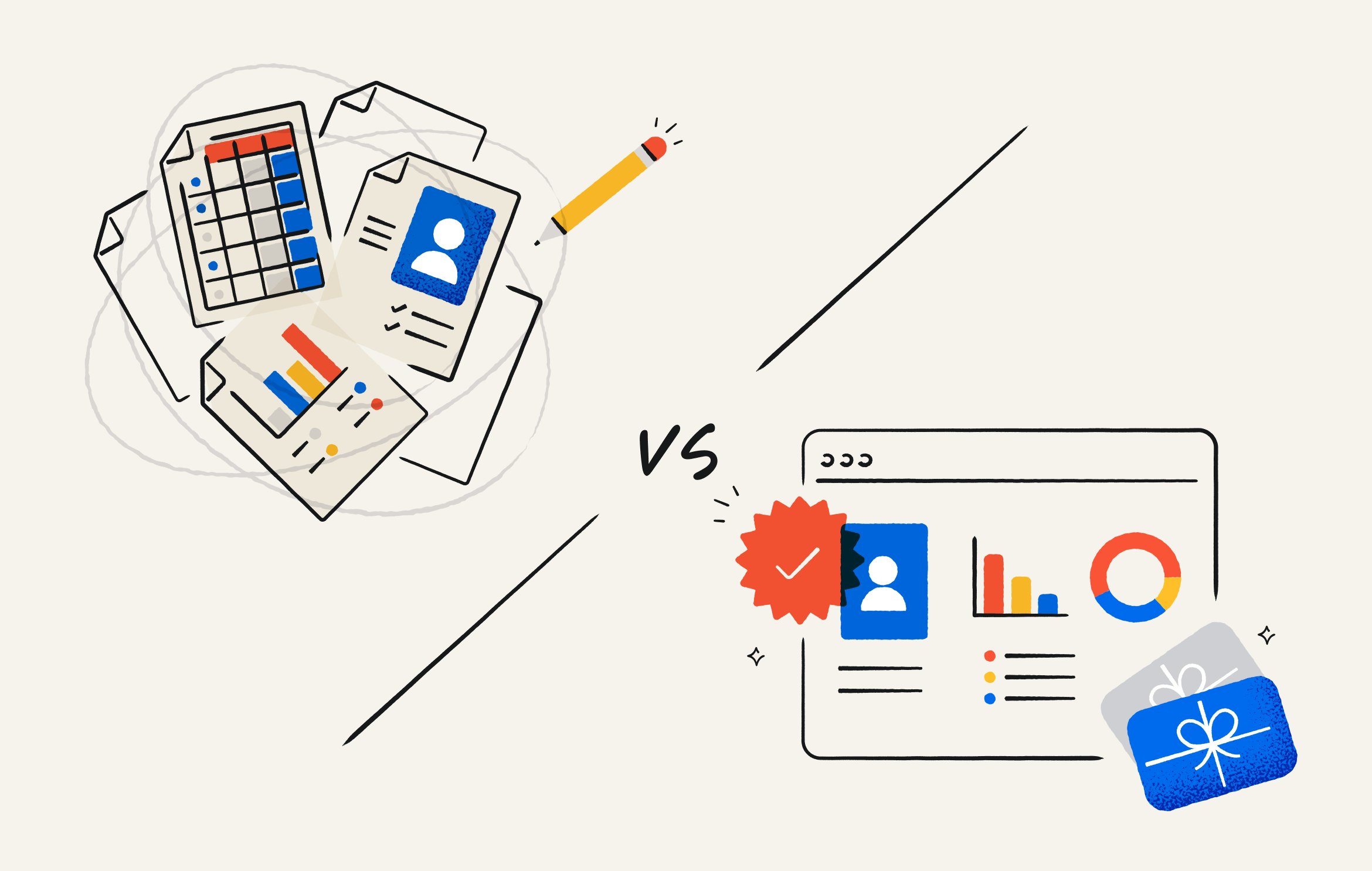
Manual vs. automated reward delivery
Here’s how manual and automated reward payouts compare across the factors that matter for incentives teams:
| Manual | Automated | |
|---|---|---|
| Time | Labor-intensive delivery, tracking, and reconciliation | Streamlined workflows save significant time |
| Scale | Requires more staff or creates delays as volume grows | Scales without a proportional increase in effort |
| Tracking | Fragmented across spreadsheets, emails, and disconnected tools | Centralized tracking with real-time reporting |
| Recipient choice | Dependent on manual processes and individual decisions | Rules-based systems enable personalized, localized options |
| Budget control | Higher risk of errors and fraud can lead to budget leakage | Automated validation, fraud detection, and real-time monitoring protect spend |
How to move from spreadsheets to automation
Start small with just one incentive program and a limited number of recipients, and follow these steps:
Map your incentive triggers
Decide which events will trigger an incentive workflow. Common triggers include:
Creating an account or signing up on a website
Taking a demo or trying a product
Completing onboarding
Leaving a review or providing feedback
Reaching a purchase milestone or spending threshold
Referring a product or service to another customer
Attending an event or webinar
Define each trigger carefully. For example, specify whether a referring customer earns a reward when they make the referral or when the referred customer makes a purchase.
Next, set the exact eligibility rules for earning a reward. Determine whether the customer must:
Be a first-time or repeat customer
Spend over a specific amount
Be in a specific country or region
Complete the action within a set time window, like leaving a review within 30 days of a purchase
Avoid any disqualifying situations, like returning an order
Then decide whether a customer can earn multiple incentives from the same action or just one.
Decide your reward mix
Different recipients prefer different incentives, depending on their age, location, and interests. Tremendous research suggests all age groups value monetary options, like digital wallets, ACH, and flexibility. More than half (53%) of recipients in the survey said they wanted to be able to spend their rewards anywhere.
At the same time, 48% said they'd be fine with a gift card if it was for a retailer they already shop at. Giving recipients a wide range of reward types to choose from is often the safest bet. Whatever the mix, keep redemption simple, with minimal steps and personal details.
Choose your connection method
When you work with an incentive platform, you can usually choose from several methods to connect the platform to your recipient information and send rewards in bulk:
CSV upload: Your team formats a spreadsheet with columns for email, name, amount, and message, then uploads it to the platform.
Native integrations: Your incentive team uses prebuilt connections to share data and trigger rewards without the need for coding.
API integrations: Your developers connect your CRM to the platform to trigger rewards based on specific events.
Set rules and approval gates
Define which rewards the platform sends automatically and which need a human review first. It's usually best to require approval for high-value rewards above a set amount.
Build in tracking and reporting
Attribution gets harder as third-party cookies fade, but your incentive program can help your marketing team see which actions lead to conversions. Eight in 10 marketers use loyalty programs to capture data, according to Salesforce. It works best when you assign unique codes to track incentive offers and set up reporting from the start.
Add fraud controls
Protect your program budget by choosing an incentive platform with multi-layered security, such as SOC 2 certification, data encryption, and access controls for your team. The platform should also monitor for signs of incentive fraud, such as reused IP addresses, participant country mismatches, reused payment details, and multiple emails tied to the same device.
Test, then scale
Now you're ready to send. Confirm your triggers, reward mix, integrations, approvals, reporting, and fraud controls all work as expected, then expand to automate more programs.


Marketing use cases where automation pays off most
Automation cuts manual work across most incentive programs, from enrollment and eligibility checks to distribution, attribution, fraud detection, follow-up messages, and reporting. A few use cases get an outsized payoff:
Sign-up and acquisition incentives
Nearly three-quarters (70.22%) of online carts are abandoned. A well-timed incentive can be the nudge a customer needs to finish a purchase, try a new service, or download an app. These incentives usually fire the instant someone converts, so automation earns its keep by checking eligibility and catching fraud in real time.
Referral programs
Who do you trust more on a company recommendation: a friend or the company's own marketing? Referral programs work because they run on that trust. Customers acquired through referrals go on to make 31% to 57% more referrals themselves than other customers. Because these programs usually reward both the referrer and the referred, automation does the heavy lifting of tracking unique referral codes, managing multi-step rewards, and reducing fraud as volume grows.
Cashback and rebates
Cashback and rebate programs lift both purchases and loyalty, but they're labor-intensive to run, since teams have to verify purchases and often calculate a percentage of each spend. Here, automation handles eligibility checks, receipt and transaction processing, fraud detection, and payout math.
Loyalty and rewards programs
The majority (85%) of consumers say they're more likely to keep buying from brands with strong loyalty programs. These are complex to manage, with points, tiers, and spending thresholds in play. Automation keeps them running: calculating points, managing tier status, personalizing rewards for birthdays and milestones, flagging reward abuse, and tracking unused points as a financial liability.
Event, webinar, and demo participation incentives
Incentives increase attendance at webinars, demos, and events. Gift cards boost webinar attendance by an average of 30.9%, according to one analysis. From registration tracking to attendance verification, reminders, and post-event delivery, automation covers the busywork that otherwise eats into a small events team.
What to look for in an incentive automation platform
The best solutions make it simple to send high-volume rewards triggered automatically by customer actions, so your team doesn’t need to set up manual campaigns every time. Key capabilities include:
Integrations with your existing stack: A developer-friendly API connects the platform to your CRM and other marketing systems, so incentives fire straight from the workflows you already run.
Global reach: International reward delivery should cover locally relevant reward options, language localization, and automatic currency conversion.
Visibility into program performance: A real-time reporting dashboard lets you track delivery, redemption, and program spend.
Built-in fraud prevention: Strong fraud controls help detect and block suspicious activity before rewards are issued.
Predictable, transparent pricing: Clear pricing with no subscription or platform fees makes costs easier to forecast.
Recipient support: A dedicated support team handles delivery and redemption questions so your team isn't the help desk.
Common automation mistakes to avoid
Automation helps your team scale, but only when the workflows behind it are built with care. Watch for these mistakes as you ramp up:
Automating without approval gates: Speed is the point, but high-value sends still need a human check to head off costly errors or fraud.
Automating before your rules are set: Automation is only as good as the logic under it. Vague triggers or fuzzy eligibility rules turn small mistakes into big ones at scale.
Setting it and forgetting it: Keep an eye on send volume, redemption, and engagement so you catch problems before they dent your ROI.
Letting the recipient experience slip: A clunky redemption flow, delayed rewards, or poor communication can sour customers on the whole program.
Not tracking automated spend: Watch reward spend against budget in real time so your program stays profitable.
Let automation do the work
The hard part of scaling a rewards program was never the rewards. It's the manual work around them: checking eligibility, sending incentives, watching for fraud, and reconciling payouts. The bigger the program gets, the heavier that work becomes.
Automation lets teams grow their incentive programs without piling on administrative overhead. When rules-based workflows handle delivery, tracking, and fraud detection, your team spends less time running the program and more time making it better.