Synthetic data vs. human insights: How to know what your research needs
By Izabelle Hundrev●6 min. read●Aug 24, 2026

Ask a large language model (LLM) how a 34-year-old nurse in Ohio might react to your new product packaging, and you’ll have an answer in seconds. No screeners, field time, or incentives required.
That’s the appeal of AI-generated synthetic data, and researchers are paying attention. A Qualtrics survey found that 69% of global researchers reported using synthetic responses in the past year.
But data confidence is a separate matter. In another study, 60% of researchers opposed the use of synthetic samples, citing concerns about ethics, trust, reliability, and authenticity. And one recent trends report found that 43% of researchers aren’t excited about synthetic respondents, even though they welcome AI for analysis tasks.
The speed and accessibility of insights offered by AI can be genuinely useful. But it also raises an interesting question: When does a model’s prediction provide enough signal, and when does a research project still require input from real people?
The answer depends on what you’re trying to learn through your study, how much uncertainty you can tolerate, and what’s at stake if the research is off the mark.
What synthetic data can tell researchers
Synthetic data is most useful when research teams need to explore possibilities quickly. A few common use cases include:
Pressure-testing a questionnaire before it goes into the field: AI can flag confusing wording, weak answer choices, or potential issues with survey flow.
Narrowing a long list of ideas: If you have 40 concepts but only budget to test eight of them with people, synthetic responses can help you hone in on the ones worth paying for.
Exploring possible audience reactions early: Run a concept, message, or price point by a model to get a directional read before committing to testing with participants. This is especially useful when recruitment is difficult or you have limited time.
The upside: You get results quickly and can rerun your analysis with different assumptions without paying to field multiple times. For the jobs they’re suited to, synthetic responses can work well. In the Qualtrics report cited earlier, 87% of researchers who had used synthetic data reported high satisfaction with the results.
There’s a noteworthy pattern in this list of use cases. All of them involve exploring what’s possible or testing an early idea. Synthetic data can estimate how people are likely to respond based on information the system already has access to. What it can’t do is generate new insights from real people.

Why plausible responses aren’t the same as authentic insights
Synthetic responses are estimates, even as models improve. A better model can produce a better estimate, and those estimates can be very good. But greater accuracy doesn’t turn a prediction into a real observation of what a person actually said or did.
Another challenge is that models can smooth out some of the messiness that makes human insight useful. Synthetic responses sound remarkably convincing. They’re coherent, well-organized, and consistent. But real participants often aren’t. Humans can contradict themselves, use unexpected language, change their minds, and bring up ideas you never thought to ask about.
Synthetic models generate responses based on patterns in the information available to them. That can be exactly what you need when you’re testing a known possibility. But researchers know that often the most useful finding is the one you didn’t expect. It’s the participant who uses your product in a way you never designed for, or the one whose brand objection reveals a problem that hadn’t surfaced elsewhere.
Synthetic responses also reflect the assumptions and biases built into the prompt or source data. If you ask a model to evaluate an idea using the audience, hypothesis, and language it already has, the output might reinforce that framing rather than challenge it. A real participant can push back, ask what you mean, or answer a different question than the one you asked.
None of this means synthetic data is inherently unreliable. But it does require researchers to distinguish between a plausible response and concrete evidence from the people they’re trying to understand.
Where human insight matters most
Some questions can’t be answered well by a system that relies on existing information. These are the situations where direct research still plays a starring role.
Discovering something entirely new
New product categories, emerging behaviors, and poorly understood problems are difficult to model because there isn’t much existing information to work from. Real participants can bring up unexpected responses: a new way to refer to something, a workaround they invented, or a completely new use case.
Understanding the context behind an answer
People rarely make decisions in isolation. Their environment, emotions, relationships, and past experiences all influence their opinions and behaviors. Talking directly with participants gives researchers the chance to follow up, ask why, or dig into an answer that doesn’t make sense.
Observing what people do
What people say they’ll do doesn’t always match what they actually do. That’s why user testing and contextual inquiry exist. Watching someone live can surface confusion, hesitation, and other behaviors that a participant might not think to report, and an AI model might not predict.
Studying audiences that are poorly represented in existing data
Some audiences are hard for AI to simulate: people with specialized expertise, hard-to-reach populations, groups undergoing rapid change, and communities whose experiences aren’t well documented. A model’s estimate of these groups rests on whatever sparse or dated materials are available. The output can still sound confident even though it’s based on limited or outdated source data. Direct research is needed to fill in those gaps.
Making high-stakes decisions
A rough synthetic response might be enough for an early concept test, but it’s harder to use as the sole input when research is informing important decisions like medical care, regulatory requirements, major product launches, or other decisions that are hard to reverse.
The greater the cost of a wrong conclusion, the stronger the case for validating it with real people.
When to use synthetic vs. human data
There isn’t a universal rule that applies to every study. Before choosing a data source, consider these four questions:
Am I exploring known possibilities or trying to uncover something new? Exploration within a defined space can be a good fit for synthetic data. If the goal is to discover new needs or behaviors, direct research is the better choice.
If this answer were wrong, would I be able to tell? A bad synthetic response looks very similar to a good one. Is your research process built to identify it? If you have reliable checkpoints to pressure-test responses, tapping synthetic data may be a reasonable risk. If the finding is unlikely to be validated elsewhere, collecting human input becomes more important.
What’s the cost of being wrong? A plausible answer might be enough when the decision is easily reversible or low-stakes. That changes when a bad assumption could lead to a costly product decision or shape a high-stakes recommendation. This is especially true in highly regulated industries like healthcare and finance.
Does this data need to accurately reflect a population? Sometimes a directional read is sufficient to meet your objective, as long as it isn’t presented as if it were a direct measurement. If your study depends on accurately representing a specific population, collecting human input is the more reliable approach.
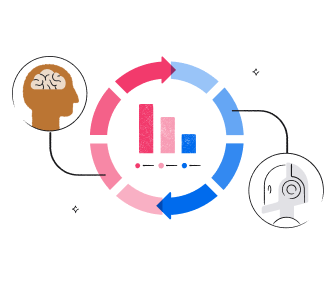
Depending on your research goals, audience, and design, you may tap human research, synthetic data, or a mix of both. A research process that combines the two could look something like this:
AI-assisted secondary research to map what’s already known
Synthetic data to explore possible outcomes and narrow the field before recruiting
Direct human research to discover, add context, and validate
AI-assisted analysis to work through the results efficiently
The exact sequence will vary by study, but the principle stays the same: what matters is using the right method to get evidence that's strong enough to support your key decisions.
How to collect high-quality human input
Every researcher knows that tapping people for insights doesn’t automatically guarantee good data. When a study involves human participants, the quality of what you learn depends on who you talk to, how you gather information, and how you reward participants for their time.
Match the research method to the objective
Start with your research objective before choosing a methodology. Interviews get at motivations and surface language people actually use. Observational methods are better for understanding real-world behavior. Surveys can show how widespread a view is across a large group.
If you choose the wrong one, you’ll end up with genuine human responses that don’t answer what you set out to learn.
Recruit for relevance, not just volume
A response isn’t useful just because it came from a real person. Participants still need the experience or knowledge that your research questions depend on. Vetted research panels or trusted recruitment partners can help filter out unqualified or fraudulent respondents.
This matters even more for the audiences that AI struggles to simulate. Where synthetic data is weakest, recruitment quality becomes more important.
Build a thoughtful incentive strategy
Match your incentive value to the time, effort, expertise, and sensitivity required to participate. A 60-minute interview about a personal health experience should offer a higher incentive than a five-minute consumer product survey.
How and when you send the incentive matters, too. Holding a reward until a respondent passes validation can make it harder to game a study just for the payout. This is especially relevant today, when bad actors frequently use fake AI-generated responses to pass quality checks.
Once a participant has done their part, send their incentive quickly and make it easy to redeem. A smooth redemption experience builds trust with high-quality participants and can make them more willing to take part in future studies.
Use AI to speed up analysis without outsourcing human judgment
AI can be useful for organizing responses, clustering themes, and summarizing large volumes of qualitative feedback. What stays with the researcher is deciding which themes matter, investigating contradictions, and connecting findings back to the original study objective.
What’s next for research teams
As synthetic data handles more early-stage exploratory work, teams might not need to run as many studies to confirm what’s already well understood. Instead, they can spend more time investigating uncertainty, observing actual behaviors, and uncovering new evidence from real human experiences.
The teams getting the most out of synthetic data aren’t removing people from the process. They’re the ones making good judgment calls about when a synthetic estimate is sufficient, and when direct human input is worth the added time and budget.