Ad hoc gift cards vs. incentive platforms: Which is right for your business?
By Izabelle Hundrev●3 min. read●Mar 10, 2026
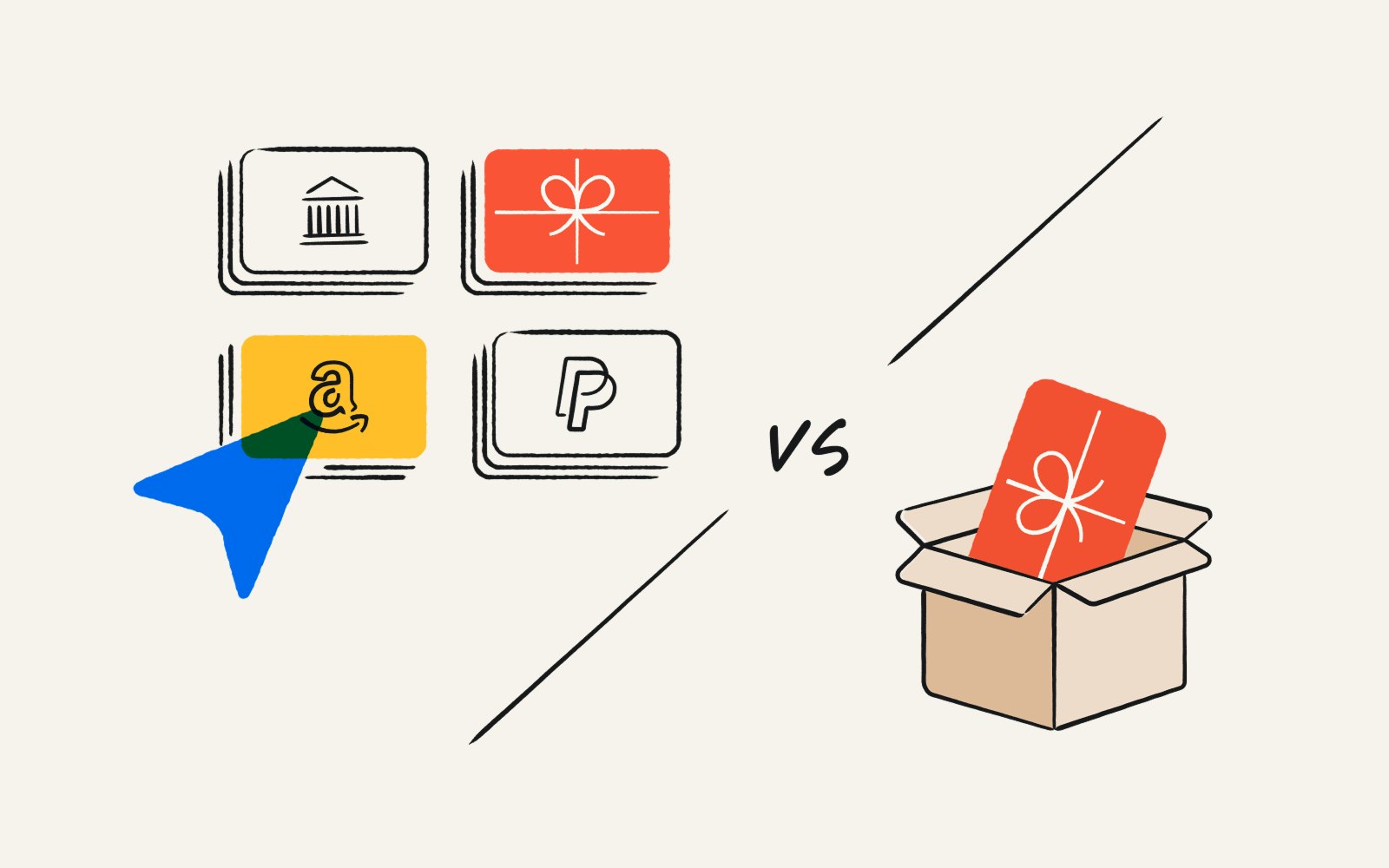
It usually starts like this: You need to send rewards to a group of people, so you go to a retail website, buy a batch of gift cards, and email them out one by one. You track who’s received what in a spreadsheet to stay organized.
This is the ad hoc approach to gift cards. It’s how many businesses start, and at a small scale, it works. But as you send more rewards, what once felt manageable can quickly become time-consuming and difficult to track.
Below, we break down the drawbacks of ad hoc sending, what an incentive platform does differently, and how to decide which approach is right for your business.
The drawbacks of sending gift cards ad hoc
If your team is sending more than a few gift cards a year, ad hoc sending can become difficult to sustain. Here’s why.
It eats up your team’s time: Manually buying, distributing, and tracking gift cards is tedious work. Every reward requires someone to source it, log it, and follow up when something goes wrong. Multiply that by dozens or hundreds of recipients, and the admin hours add up fast.
The recipient experience is limited: When you're buying gift cards from a single retailer, the recipient is restricted to that retailer’s catalog. Limited choices can make a well-intentioned reward feel less thoughtful. Delivery can also be inconsistent. A plain email with a link is easy to overlook, and if a reward expires before it’s redeemed, it might not have the same positive impact.
There’s little visibility into performance: With the ad hoc approach, tracking is usually done in a spreadsheet. Did my email send? Did the recipient open it? If someone claims they never received a gift card code, verifying it can be difficult. Without reliable reporting, it’s hard to measure program effectiveness or troubleshoot problems quickly.
Compliance and record-keeping get tricky: In the US, gift cards are taxable if they exceed an annual threshold. Businesses that issue them regularly need documentation. When distribution happens through a patchwork of emails and spreadsheets, producing a clean record for auditing or tax reporting is time-consuming and error-prone. There's also a real fraud risk. Without proper controls, gift card codes can be intercepted or misused.
What an incentive platform does differently
An incentive platform is designed to address operational challenges as your gift card program grows.
Speed and scale: Instead of distributing rewards one at a time, you can send to hundreds or thousands of recipients in a single batch. Upload a list, set your reward amounts, and start sending — or use an API or integration to automatically send gift cards.
More choices for recipients: Rather than locking recipients into one retailer, an incentive platform gives them a catalog of options to choose from: gift cards, prepaid cards, monetary options like PayPal or ACH, and even charitable donations. When people can choose their own rewards, they're more likely to use them.
Real-time tracking and reporting: You can see exactly who received a reward, how much it’s for, and when they opened it. That visibility makes it easy to follow up with recipients who may need help and gives you the data to measure program success.
Compliance support and fraud prevention: A sophisticated platform can handle tax documentation and audit trails, which are difficult to manage manually. Many also include built-in safeguards to reduce fraud risk, such as secure delivery methods, access controls, and fraud-prevention tools.
One common reason teams stick with the ad hoc route is the assumption that a platform means a monthly subscription fee. That's not always true. Some platforms like Tremendous are free to use, with no subscription fees or order minimums. You only pay for the rewards you send.


When to make the switch
If you're sending a handful of gift cards a year with no plans to scale, ad hoc might be fine. But it's worth considering a platform if any of the following ring true:
You're regularly sending rewards to more than a few people at a time
You need documentation for compliance or auditing purposes
Recipients frequently ask for help or never redeem their rewards
You’ve had issues with stolen or lost gift card codes
Your team is spending significant time managing payout logistics
The threshold is different for every business. If sending rewards starts to feel like a part-time job, there’s a better option.
Final thoughts
If you’re only sending a few gift cards a year, an ad hoc approach works. It's simple, accessible, and for occasional sends, it may be all you need. But if rewards are becoming a bigger part of your day-to-day work, it's worth investing in a scalable solution so your team can keep up.
An incentive platform reduces manual admin work, improves the recipient experience, and gives your team the visibility and controls you need to run a program that drives results.