Rapid UX research: A 48-hour workflow (what to cut, what not to cut)
By Abby Quillen●6 min. read●Jul 15, 2026
Quick answer: Rapid UX research is a compressed research process that delivers actionable user insights in days instead of weeks or months. It works by tightening scope to a single question and relying on standardized templates and pre-vetted participants, which makes evaluative and tactical studies possible in as little as 48 hours.
Stakeholders want answers by Friday, not the next sprint. That expectation keeps climbing: in Maze's 2026 Future of User Research report, 66% of product professionals reported rising demand for research, up from 55% the year before. The challenge is that the systems behind most research programs weren't built for that pace. As one researcher surveyed in the report put it, "Stakeholders are increasingly asking for faster turnaround, even if the research is less comprehensive."
That pressure puts researchers in a bind. Traditional cycles run for weeks or months, and they weren't built for speed. But when the scope is tight and the question is clear, a rapid study can surface useful insights in a fraction of the time.
Below, you'll find a practical framework for running a rapid study in 48 hours, plus clear guidance on which shortcuts are safe and which ones can quietly undermine your findings.
What "rapid" actually means in UX research
Rapid user research isn't a euphemism for rushed or careless work. A rapid study earns its speed through preparation, not shortcuts: a tightly scoped question, templates you're not building from scratch, and participants who are already vetted and ready to go.
It's also distinct from a design sprint, even though both prize fast learning. Rapid research exists to understand users and sharpen your thinking, assumptions, or strategy. A design sprint exists to build and test a solution to a specific problem, usually over four to five days. Same speed, different goals.
It pays to be realistic about what fits in the window. Rapid research works well for evaluative, tactical questions with a defined scope, like narrowing down concept options or validating something you already suspect. It's the wrong tool for foundational discovery or deep exploratory work that calls for longitudinal diary studies, large-scale surveys, or long-form interviews.
The 48-hour rapid UX research framework
This framework moves you from a defined research question to a shareable readout in two working days. Each phase is tightly scoped, and each one comes with a call on what's worth protecting and what you can safely compress. Treat it as a decision guide, not just a schedule.
The clock only works in your favor if the right systems are in place before it starts. At a minimum, have discussion guide templates ready to adapt so you're not writing objectives, questions, and session structure from scratch under pressure.
Beyond that, three tools carry most of the operational load, and each one addresses a bottleneck that tends to surface on a compressed timeline:
A recruiting platform to source, screen, and schedule participants who match your criteria.
A synthesis tool to organize, analyze, and spot patterns across your data as it comes in.
A participant incentive delivery platform to manage and distribute participant compensation, with tracking, fraud prevention, and compliance support built in.
Hour 0–4: Define the question
Before you do anything else, align with stakeholders to determine a single, answerable research question. Avoid compound or exploratory questions, which can delay your timeline before fieldwork begins.
Assign clear team roles upfront. Decide who will moderate the study, take notes, own synthesis, and present the readout. Ambiguity about the scope of the research question or team roles can cost your team hours later.
Don't cut this stage: Rushing scope definition is the most common reason rapid studies fall apart.
Hour 4–16: Recruit and confirm participants
Once you’ve locked the question in, move fast on participants. If you have an internal CRM, you may be able to source participants from your own database. But for a compressed timeline, it may make more sense to partner with a recruiting platform, such as User Interviews or Respondent, that can quickly match you with quality participants who fit your criteria.
Incentives do a lot of quiet work here. Research from Great Question found that no-show rates climb to 20–25% when incentives fall short, and drop to 5–10% when they're set appropriately. Inadequate incentives can also stretch recruitment two to three times longer than planned. So confirm your participant incentive delivery method before outreach begins, and spell out the incentive clearly in your first message. A confirmation note or a simple reminder goes a long way toward keeping no-shows down.
What you can cut: the extended custom screener built from scratch. Instead, a tight, standardized screener with three to five criteria will get you qualified participants without the extra build time.


Hour 16–32: Run a pilot, then go live
Run one internal pilot before you bring in live participants. Thirty minutes pressure-testing your discussion guide and prototype can save hours of mid-study corrections.
Once you're live, keep sessions to 30 to 45 minutes each. You'll likely run them back-to-back to stay on schedule, and longer sessions tend to erode focus and degrade note quality as the day wears on.
What you can cut: back-channel debrief meetings between every session. A shared notes doc with timestamped observations lets your team align asynchronously instead.
Hour 16–40: Synthesize as you go
This phase overlaps with your sessions on purpose. Don’t wait until your team has completed all of the sessions to begin synthesis. Begin tagging observations and clustering themes after the first session. Using one of these collaborative software programs can help keep the process organized:
Dovetail: This specialized AI-assisted repository and analysis platform helps teams collect, analyze, and collaborate on research data.
Miro: This visual online platform allows teams to create collaborative boards with a built-in AI assistant to help synthesize research.
Google Sheets: Teams can collaborate in real time on a shared spreadsheet.
In a rapid cycle, you don't need to wait for saturation, the point in traditional UX research where new participants stop surfacing new insights. If three to five participants show the same behavior, consider it a sufficient signal for tactical decisions.
Ideally, involve stakeholders in live debriefs after each session. Aligning in real time builds organizational buy-in and eliminates the need for a separate step to socialize the research before your team delivers the readout.
What you can cut: exhaustive documentation of every observation. Prioritize the patterns that repeat across participants, the quotes that stand out, and the actions you'd recommend.
Hour 40–48: Create and deliver the readout
In the final stretch, build a one-pager or a lightweight slide deck. Keep it to the essentials:
The research question you set out to answer
The findings that emerged
A few supporting quotes
Your prioritized recommendations
Put a short summary at the top so stakeholders who didn't sit in on sessions can orient themselves fast. Where it helps, add a simple chart or graph to make a finding easier to grasp.
What you can cut: the polished, design-heavy deck. The goal of a rapid study is a decision, not a beautiful deliverable.
Cut vs. keep: a quick reference
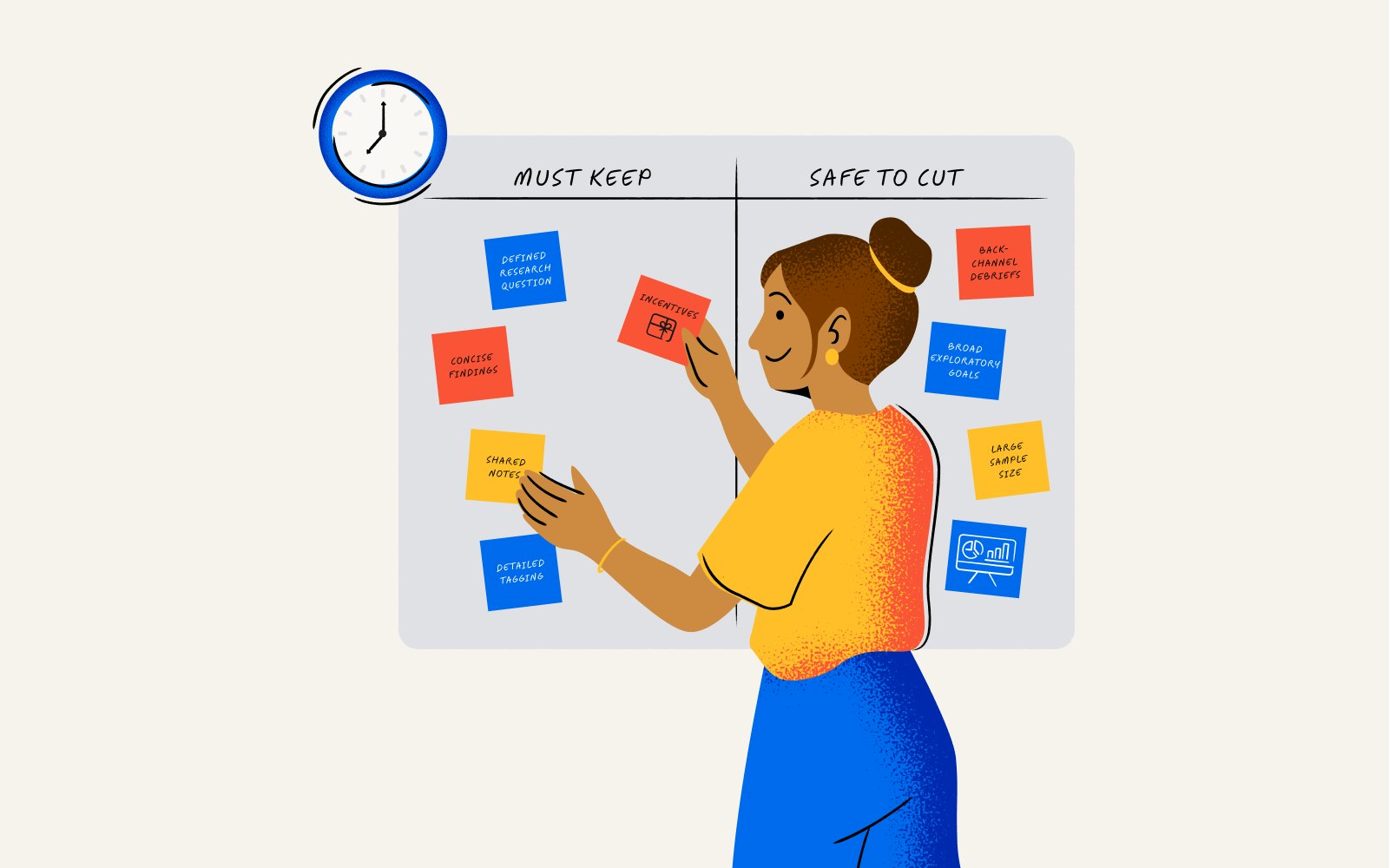
Use this as a reference card you can return to without rereading the full framework. Just remember that "safe to cut" is conditional, not a default. Every choice here is a conscious trade-off, and the right one depends on your study, your timeline, and what you need to learn.
| Phase | Safe to cut | Don’t cut this | Potential trade-offs |
|---|---|---|---|
| Scoping | Broad exploratory goals and secondary objectives | A tightly defined research question and clear team roles | Narrowing the scope speeds recruitment, moderation, and synthesis but limits how much exploratory insight the study can reveal. |
| Recruitment | A large sample size and an extended custom screener questionnaire | Participants who match your target audience, a tight, standardized screener, and incentives that match the effort you're asking for | Simplifying recruitment helps teams move quickly, but reducing participant count lowers confidence. |
| Sessions | Back-channel debrief meetings between every session | Shared notes and asynchronous alignment | Skipping live debriefs saves time, but your team loses chances to spot patterns and adjust moderation on the fly. |
| Synthesis | Exhaustive documentation of every observation | Real-time clustering and tagging, plus quick stakeholder debriefs | Trimming documentation saves time, but cutting synthesis too far risks reacting to one-off comments instead of real patterns. |
| Readout | A long presentation or a polished report | Concise findings and clear recommendations | Stakeholders need clear findings and next steps more than a polished deliverable, but they still need to see the evidence behind your recommendations. |
Participant incentives are critical to success
Participant incentives are one of the most overlooked operational variables in rapid research timelines. They’re critical when you need to recruit quickly and encourage participants to show up and engage. If your incentives fail, your team may face delayed confirmations and no-shows, which wastes time you can't recover in a 48-hour window.
Which incentives work best for rapid research?
Incentive types that work best for fast turnarounds include:
Digital gift cards
Monetary options such as PayPal, Venmo, or ACH
Recipient-choice platforms that allow participants to select their preferred incentive
Letting participants choose isn't only about satisfaction. When people receive an incentive they actually want, they have more reason to show up and follow through. In one study, participants preferred the option to choose a reward even over receiving the highest-value option.
How to limit incentives fraud
If you’re sending incentives manually, your team may be vulnerable to incentives fraud. Bad actors target research studies to steal incentive dollars. They may misrepresent their identity, fake product usage, or fill out multiple surveys. Because manual workflows lack tracking and automated controls, it’s easier for bad actors to slip through.
By partnering with an incentive platform like Tremendous, you benefit from built-in fraud detection. The incentives platform automates participant incentive delivery globally and offers 2,500+ incentive options in 230+ countries and regions. It removes manual administrative work that slows recruitment, so your team can focus on the research itself.
Run faster studies without cutting corners
When stakeholders need answers fast, rapid research helps your team understand what users need without holding up the decisions that depend on it. You can use the framework above to surface high-quality insights on a narrowly defined research question in just 48 hours.
Participant incentives are the part teams most often underestimate. Rapid research depends on fast recruitment and engaged participants. The right incentives can help your team fill sessions quickly, reduce no-shows, and maintain response quality under tight timelines.