Who’s buying and using gift cards? A data-backed profile
By Mindy Woodall●4 min. read●Aug 25, 2026
Gift cards are one of the most common ways businesses reward people, whether that's a research participant taking a survey, a customer sharing a referral, or an employee hitting a work milestone.
There's a simple reason the gift card format has held up well with consumers: it gives recipients the freedom to pick something they want while still keeping the feeling of a gift. Between prepaid and merchant-specific options, there's a card for almost any way people like to shop, which makes a gift card a low-effort, low-risk way for businesses to offer real value to wide audiences.
But building a reward program that actually lands means understanding your recipients’ preferences, and the best place to gather intel is by looking at who buys and uses gift cards in the first place.
The Tremendous and Visa report on gift card behavior, based on MRI Simmons consumer research, profiles the average U.S. gift card buyer in detail. Here's what that person looks like.
Key takeaways
57% of gift card buyers are women, and 76% own their home.
Baby boomers and millennials account for 67% of all gift card purchases.
More than half come from households earning over $100,000 a year.
43% hold a bachelor's degree or higher.
62% of buyers picked up more than three gift cards in the past six months.
The profile shifts by region: buyers skew male only in the South Atlantic, and oldest and most affluent in New England.
The typical buyer is affluent, established, and skews female
Start with the demographics, and a clear pattern emerges. The average gift card buyer tends to be older, more affluent, and more likely to be a woman than the general population. Women account for 57% of gift card purchases.
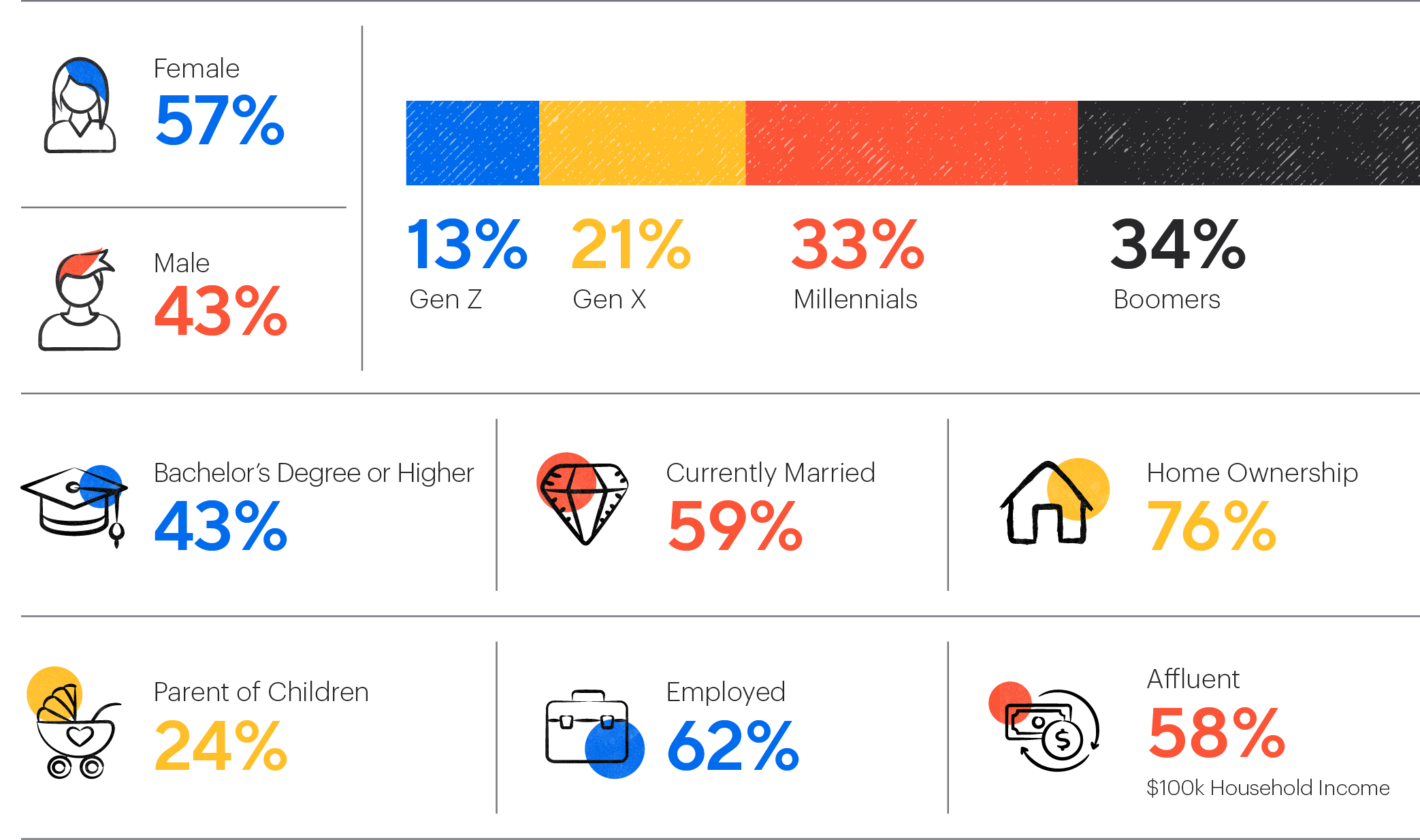
The typical buyer is also financially settled: 76% own their home, 59% are married, and 62% are employed. More than half come from households earning over $100,000 a year, and 43% hold a bachelor's degree or higher. About a quarter (24%) are parents with children still at home.
Boomers and millennials make up two-thirds of buyers
If you pictured gift cards as a younger person's go-to, the age data pushes back. Baby boomers and millennials together account for 67% of all gift card buyers, split almost evenly at 34% and 33%. Gen X makes up another 21%, leaving Gen Z at just 13%.
Gen Z's low share is worth a closer look:
Part of it is likely financial. Gen Z faces challenging economic circumstances, and as the youngest working generation, they're still earning entry-level wages and carrying student debt, which leaves less discretionary income for gifts.
Part of it is likely behavioral. Gen Z is leading the charge on paying with digital wallets, and they’ve grown up using peer-to-peer payment apps like Cash App and Venmo. For a generation used to sending money instantly and flexibly, a fixed-value gift card may feel less appealing than simply Venmo-ing a friend.
As Gen Z’s spending power grows, whether they carry this habit forward or come around to gift cards is an open question, and a meaningful one for anyone building a rewards program with younger recipients in mind.
To that end, it's worth noting that Gen Z tends to spend significantly on restaurants, bars, and beauty/personal care, all categories where gift cards fit naturally.
They buy often, and they spend real money
Gift card buying tends to be a habit rather than a one-off. In the past six months, 62% of buyers picked up more than three gift cards, and 63% spent more than $100. Gen X and boomers are the heaviest spenders of the group, which lines up with overall financial stability within these cohorts.
The spread is wide, though. About 43% of buyers spend under $50 on a card while 34% spend more than $200, so there's a real range in how much value people place on a single gift. For a business, that's a useful signal. The people most engaged with gift cards are experienced with them, which raises the bar on the redemption experience you offer.
The buyer profile shifts by region
National averages don’t always paint the whole picture. Break the data down by region, and the picture of who's buying gift cards becomes more detailed.
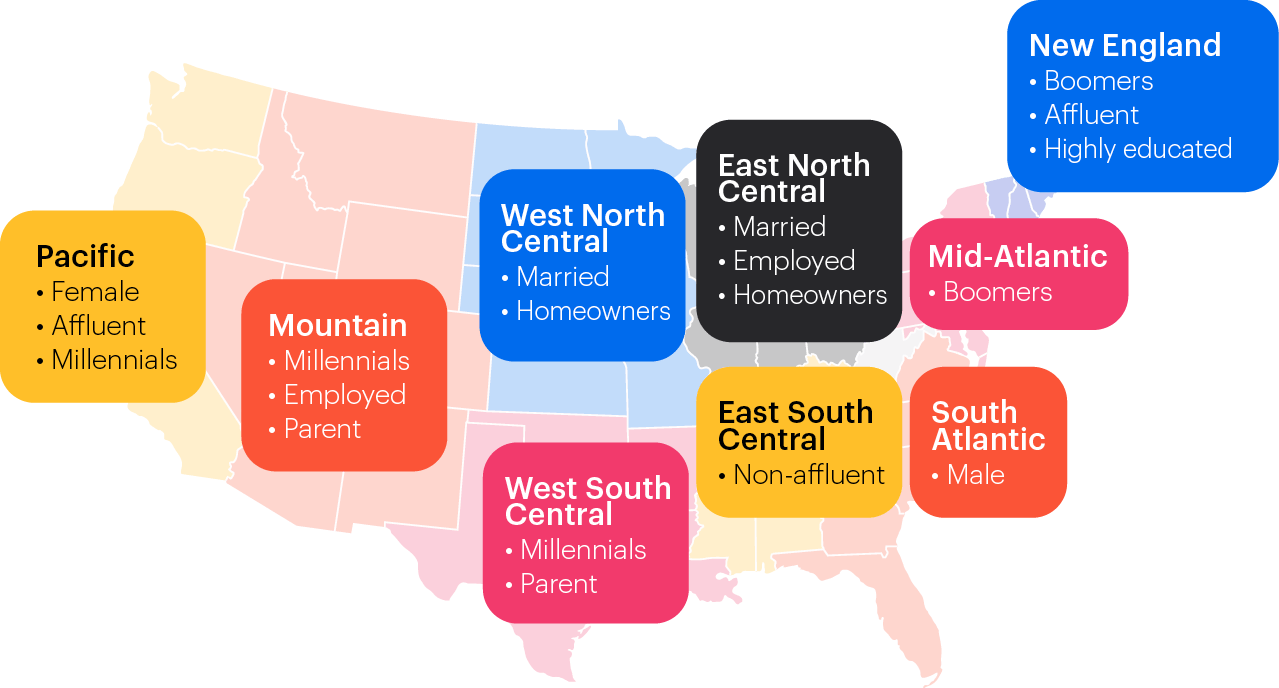
New England: Oldest, most affluent, and most highly educated buyers in the country, skewing boomer.
Mid-Atlantic: Similar to New England, also skews boomer.
Pacific: Female, affluent, and millennial.
Mountain: Millennials who are employed and raising children.
West North Central: Married homeowners.
East North Central: Married, employed homeowners.
West South Central: Millennials and parents.
South Atlantic: The one region where buyers skew male.
East South Central: Less affluent than the national average.
A few of these trends stand out. The South Atlantic is the only region that breaks the national female skew, with buyers there leaning male.
New England sits at the opposite end of the income and education scale from the East South Central states. And while both coasts share an affluent tilt, they differ on age, with the Pacific skewing millennial and the Northeast skewing boomer.
The brands buyers reach for first
When it comes to which cards people actually want, scale wins. Amazon.com tops the list at 42%, followed by restaurant cards at 34% and prepaid cards at 26%. Coffee shops (17%) and department stores (14%) round out the most popular categories.
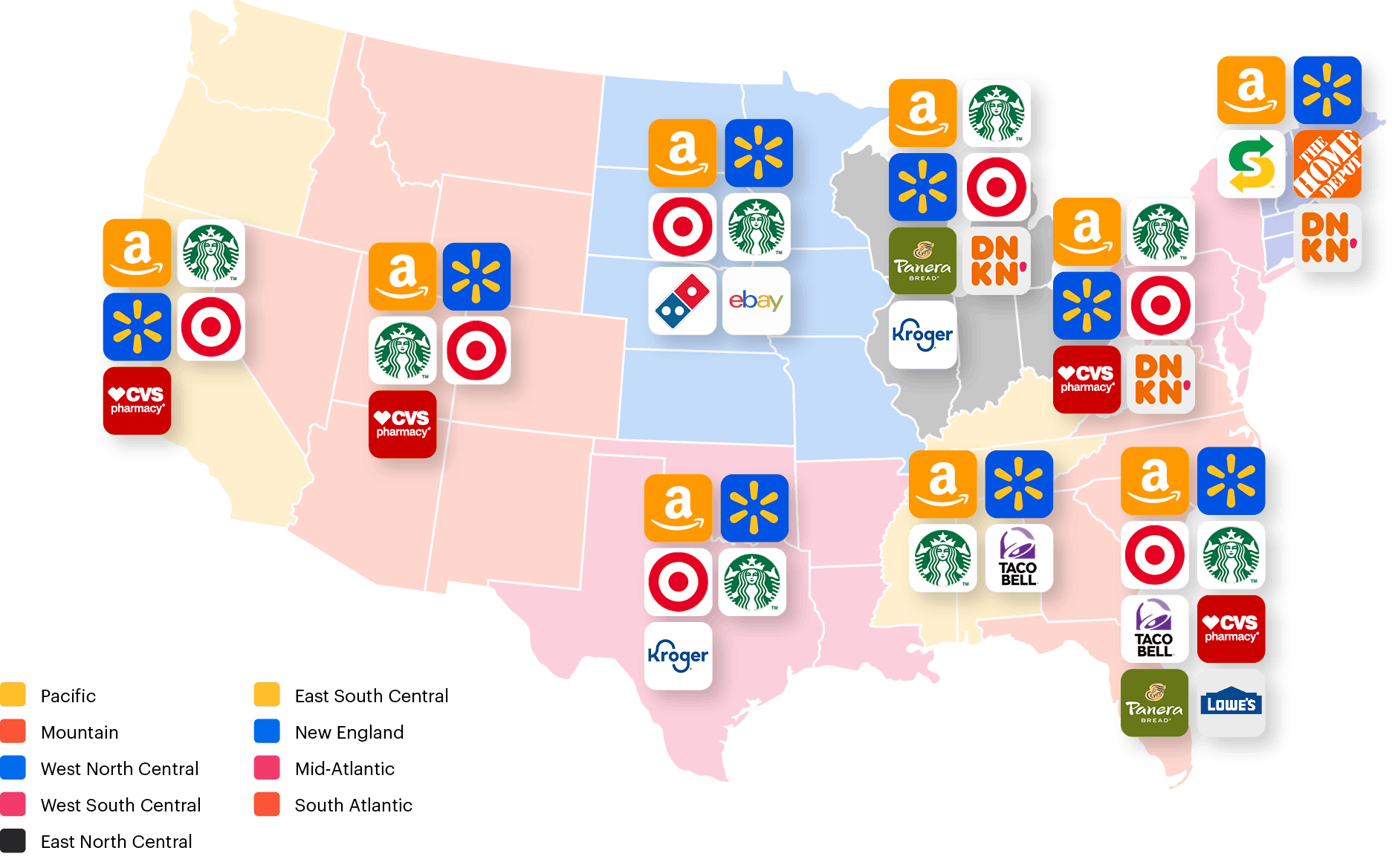
Regional preferences add a second layer. Amazon.com, Walmart, Starbucks, and Target are favorites almost everywhere, which makes them safe defaults when you don't know much about your audience.
Beyond those, taste gets local:
Dunkin' leads in the Northeast
Taco Bell is a favorite in the Southeast
Kroger is strong across the South
Domino's performs well in the Midwest
CVS shows up as a practical pick on both coasts
If you know where your recipients live, layering a regional favorite alongside the big national brands can make a reward feel more personal.
What this means for your reward programs
The average gift card buyer is financially stable and already fluent in how gift cards work. That has a few practical implications for the rewards you send, and the right move looks a little different depending on your team.
For HR and people teams, planning around the generational range is important. A workforce that runs from boomers to Gen Z won't all redeem the same way, so offer a choice of cards rather than a single option, and lean on broadly popular brands like Amazon.com, Walmart, Starbucks, and Target as safe defaults for company-wide recognition and service milestones.
For marketers running incentive and reward programs, personalize offers using what you know about your audience. If you have location data, pairing a regional favorite (Dunkin' in the Northeast, Kroger across the South) with a national brand makes a reward feel more considered. And because people who use gift cards tend to be affluent and experienced with using them, focus on the experience of the reward as much as the dollar amount.
For every team offering gift cards, two things hold:
Offer a mix of merchant-specific and prepaid cards so recipients across generations can choose what works for them, from a boomer redeeming in-store to a Gen Z recipient tapping a mobile wallet.
Keep redemption quick on any device. People this fluent with gift cards will notice friction right away.
Understanding who's buying and using gift cards won't tell you everything about your specific recipients, but it gives you a strong starting point for offering rewards people are excited to receive.
To learn more about how buyers redeem the gift cards they get, our breakdown of the top gift card trends covers the behavioral side.
Data sourced from MRI Simmons USA 2025 Fall, via the Tremendous and Visa gift card report.


